Diesel Transfer Pump What to Check Before Buying
Diesel Transfer Pumps for Beginners
Transferring diesel safely and efficiently is an important requirement in industries, fuel storage facilities, power plants, construction sites, and commercial operations. Choosing the right Diesel Transfer Pump helps maintain a consistent fuel supply, reduces operational interruptions, and supports reliable equipment performance.
However, selecting a pump involves more than checking its flow capacity or motor power. Factors such as diesel viscosity, transfer distance, operating pressure, pump construction, and installation conditions also influence performance.
For first-time buyers and industrial professionals, understanding these basic requirements makes pump selection easier. This guide explains what to check first when evaluating a diesel transfer pump for your application.
1. Understand Your Diesel Transfer Requirements
Before selecting a pump, identify how and where diesel needs to be transferred. Different applications require different pumping capacities and operating conditions.
Start by checking:
Transfer Volume: Estimate how much diesel needs to be transferred per hour.
Transfer Distance: Consider the horizontal distance between the storage tank and the destination.
Suction Lift: Check the vertical distance between the diesel source and the pump inlet.
Discharge Pressure: Determine the pressure required at the delivery point.
Operating Duration: Identify whether the pump will operate occasionally, continuously, or in multiple shifts.
Understanding these requirements helps narrow down suitable pump configurations and avoid selecting equipment with unsuitable operating specifications.
2. Check the Required Flow Rate
Flow rate is one of the most important factors when choosing a Diesel Transfer Pump. It determines how much diesel the pump can deliver within a specific period.
For example, a facility transferring diesel into storage tanks may have different capacity requirements compared with a plant supplying fuel to multiple pieces of equipment.
Before finalizing a pump, consider:
Required litres per minute or cubic metres per hour.
Expected transfer time.
Number of delivery points.
Changes in flow requirements during operation.
Always compare the required flow rate with the pump's performance curve under actual operating conditions rather than relying only on its maximum rated capacity.
3. Evaluate Pump Type and Working Principle
Different pump designs are suitable for different diesel transfer requirements. Understanding their working principles helps identify the right equipment.
Common pump types include:
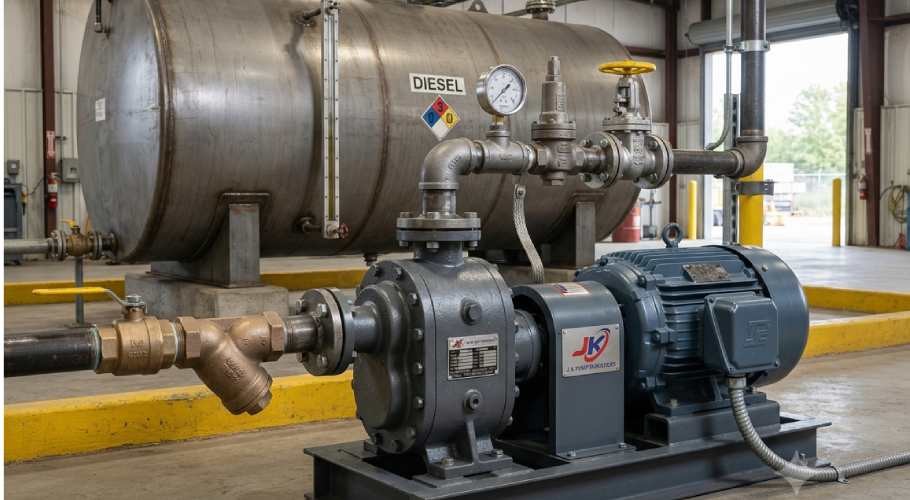
Rotary Gear Pumps: These positive displacement pumps use rotating gears to move liquid from the inlet to the outlet. They are suitable for applications requiring controlled and consistent fluid transfer, subject to the manufacturer's operating specifications.
Centrifugal Pumps: These pumps use an impeller to transfer liquid by converting rotational energy into fluid movement. They are commonly considered for applications requiring higher flow rates.
Screw Pumps: These pumps use rotating screws to move fluid and may be suitable for specific industrial fluid-transfer requirements.
The appropriate pump depends on flow, pressure, viscosity, installation, and operating conditions.
4. Check Material Compatibility with Diesel
Pump construction materials play an important role in durability and operating reliability.
Before selecting a pump, check whether its wetted components are compatible with diesel and the expected operating environment.
Important components to evaluate include:
Pump casing and internal components.
Shaft and gear materials.
Mechanical seals or other sealing arrangements.
Gaskets and elastomers.
Inlet and outlet connections.
Material selection should also account for the possibility of water contamination, fuel additives, and operating temperature variations.
5. Understand Suction and Discharge Conditions
Incorrect suction and discharge arrangements can affect pump performance and reliability.
For suction-side installation, check the following:
Suction pipe diameter and length.
Number of bends and fittings.
Vertical suction lift.
Availability of a suitable strainer.
Risk of air entering the suction line.
For the discharge side, evaluate pipe dimensions, delivery distance, valves, filters, and pressure losses.
A properly designed pipeline helps the pump operate closer to its intended performance range.
6. Consider Motor Power and Operating Conditions
Motor selection should match the pump's operating requirements.
Check the following specifications before purchasing:
Motor power rating.
Required electrical supply.
Operating speed (RPM).
Duty cycle.
Ambient temperature.
Required protection and installation classification.
An important consideration for diesel applications is the operating environment. Where flammable vapours may be present, the complete pump and motor installation must meet the applicable hazardous-area requirements. A standard motor should not be assumed suitable for such locations.
7. Check Safety and Maintenance Requirements
Diesel transfer systems require proper installation, inspection, and maintenance.
Some important precautions include:
Use compatible hoses, pipes, seals, and fittings.
Provide suitable filtration where required.
Install appropriate pressure-relief protection for positive displacement pumps.
Prevent leakage around connections and seals.
Follow the manufacturer's operating and maintenance instructions.
Ensure proper electrical protection and grounding.
Keep ignition sources away from fuel-transfer areas.
Regular inspection of seals, bearings, connections, and other critical components helps identify potential problems before they interrupt operations.
8. Choose a Reliable Diesel Transfer Pump Manufacturer
Selecting the right equipment also means evaluating the manufacturer's technical capabilities and product support.
A reliable Diesel Transfer Pump Manufacturer should provide clear technical specifications, application guidance, product information, and assistance with pump selection.
Before making a purchase, consider:
Experience in industrial pump manufacturing.
Availability of suitable pump configurations.
Technical documentation and performance data.
Material and construction specifications.
Availability of spare parts.
After-sales technical support.
Rather than selecting equipment based only on initial cost, compare its suitability for your operating requirements and long-term maintenance needs.
Common Mistakes to Avoid When Selecting a Diesel Transfer Pump
Beginners often focus only on motor power or maximum flow rate. However, overlooking other operating factors can lead to unsuitable pump selection.
Avoid these common mistakes:
Selecting a pump without calculating the required flow rate.
Ignoring suction lift and pipeline pressure losses.
Choosing incompatible sealing materials.
Overlooking diesel temperature and viscosity conditions.
Using unsuitable electrical equipment in hazardous areas.
Ignoring pressure-relief requirements for positive displacement pumps.
Purchasing without checking technical support and spare-part availability.
A proper assessment of these factors helps improve system reliability and supports efficient diesel transfer operations.
Choosing the right Diesel Transfer Pump starts with understanding your application, required flow rate, operating pressure, suction conditions, material compatibility, and safety requirements. These basic checks help beginners and experienced industrial buyers make better equipment decisions.
Working with an experienced Diesel Transfer Pump Manufacturer also makes it easier to identify suitable pump configurations and obtain application-specific technical guidance.
JK Gear Pump offers industrial pumping solutions designed for different fluid-handling requirements. Evaluate your application specifications and consult the technical team to identify a suitable pump for your diesel transfer needs.