Bitumen Pump Selection Guide: Jacketed Gear Pump vs. Tar Boiler Pump
Transferring bitumen and tar requires careful pump selection because these materials can become highly viscous or solidify when their temperature decreases. Choosing an unsuitable pump can affect material flow, operating efficiency and maintenance requirements.
Industrial buyers generally consider factors such as material viscosity, operating temperature, flow requirements, heating arrangements and installation conditions before selecting a bitumen pump.
Two options from J K Pump Industries for bitumen and tar handling applications are the Bitumen Jacketed Gear Pump (JKRBJ) and Tar Boiler Pump (JKSX). Understanding their design differences helps buyers identify the appropriate pump for their industrial requirements.
Understanding Bitumen Pump Requirements
Bitumen is a highly viscous material commonly used in road construction, asphalt production and industrial processing. Its viscosity changes with temperature, making temperature management an important consideration during pumping.
A suitable bitumen pump should be selected based on:
Material viscosity and operating temperature.
Required flow rate and discharge pressure.
Heating requirements during material transfer.
Pump size and installation arrangement.
Compatibility of construction materials with the pumped fluid.
Operating conditions and maintenance requirements.
These factors help determine the appropriate positive displacement pump configuration for the application.
1. Bitumen Jacketed Gear Pump (JKRBJ)
A Bitumen Jacketed Gear Pump is designed for handling viscous materials that require temperature maintenance during transfer.
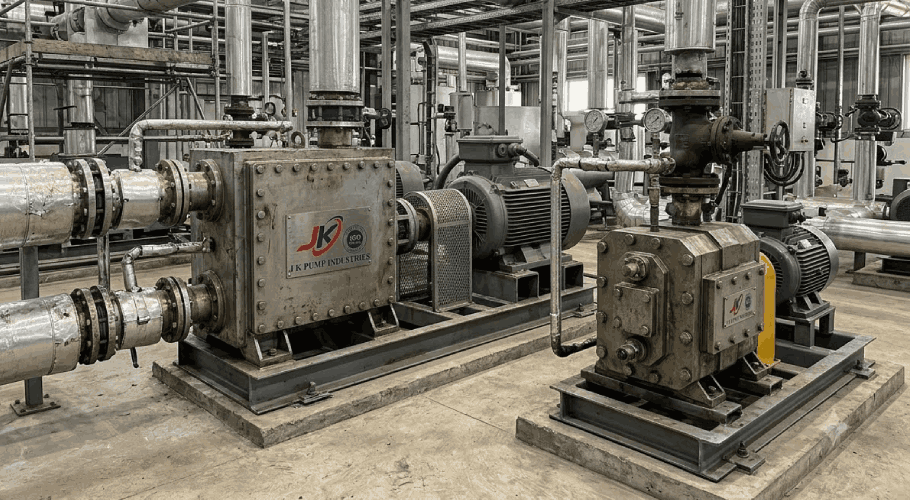
Its jacketed construction provides a heating arrangement around the pump body. Depending on the configuration, steam or another suitable heating medium can be used to help maintain material temperature and reduce the risk of solidification inside the pump.
The JKRBJ model from J K Pump Industries is designed for industrial applications involving materials such as bitumen, asphalt and other compatible viscous liquids.
Key Selection Considerations
Jacket heating arrangement.
Material viscosity and temperature requirements.
Required pumping capacity.
Operating pressure.
Compatibility with the heating medium.
Installation and maintenance requirements.
Applications
Bitumen processing plants.
Asphalt manufacturing facilities.
Hot bitumen transfer systems.
Industrial heating and processing applications.
Handling compatible viscous materials.
Explore the Bitumen Jacketed Gear Pump (JKRBJ) for product details.
2. Tar Boiler Pump / Bitumen Boiler Pump (JKSX)
A Tar Boiler Pump is used for transferring bitumen, tar and other compatible viscous materials in industrial heating and processing applications.
The JKSX model from J K Pump Industries features a compact, bidirectional positive displacement design. It includes a self-priming arrangement and relief valve, with foot and flange mounting options.
The pump is available exclusively in 25 NB (1") size. An optional high-temperature version is available up to 200°C, subject to the specified pump configuration and operating conditions.
Key Features of JKSX
Self-priming pump design.
Relief valve arrangement.
Compact and simple construction.
Foot and flange mounting options.
Bidirectional positive displacement operation.
Flanged suction and delivery connections.
Optional high-temperature version up to 200°C.
Applications
Bitumen loading and unloading.
Tar transfer operations.
Bitumen boiler applications.
Asphalt handling processes.
Compatible viscous material transfer.
Explore the Tar Boiler Pump / Bitumen Boiler Pump (JKSX) for product specifications.
Jacketed Gear Pump vs. Tar Boiler Pump: Key Differences
Both pumps serve industrial bitumen and tar handling requirements, but their selection depends on the application and heating arrangement.
| Selection Factor | Jacketed Gear Pump (JKRBJ) | Tar Boiler Pump (JKSX) |
|---|---|---|
| Main consideration | Heating jacket arrangement | Tar and bitumen transfer |
| Design | Jacketed gear pump | Positive displacement gear pump |
| Heating requirement | Jacket heating provision | Optional high-temperature version |
| Application | Temperature-sensitive viscous material handling | Bitumen and tar transfer |
| Selection focus | Heating and temperature maintenance | Transfer requirements and installation |
| Product model | JKRBJ | JKSX |
The correct choice depends on the material characteristics, required heating arrangement, flow rate, pressure and operating conditions. Buyers should consult the manufacturer before finalizing a pump configuration.
Important Factors Before Selecting a Bitumen Pump
1. Material Viscosity
Check the viscosity of the bitumen or tar at the actual operating temperature. This information helps determine the required pump capacity and operating speed.
2. Operating Temperature
Temperature plays an important role in maintaining bitumen flow characteristics. Evaluate whether the application requires a jacketed pump arrangement or another suitable temperature-control provision.
3. Flow Rate and Pressure
Determine the required material transfer capacity and discharge pressure. The pump should be selected according to the actual system requirements rather than estimated capacity.
4. Pump Construction
Check the construction materials, sealing arrangement and component compatibility with the material being transferred.
5. Installation Requirements
Consider available installation space, mounting arrangements, suction and delivery connections, and maintenance accessibility.
Why Choose J K Pump Industries for Bitumen Pump Requirements?
Selecting an industrial pump requires more than matching a product name with an application. Buyers should evaluate the material properties, operating conditions and technical specifications before choosing a suitable model.
J K Pump Industries offers different pump configurations for industrial material transfer applications, including the JKRBJ Bitumen Jacketed Gear Pump and JKSX Tar Boiler Pump.
With application-based product selection and technical support, the company helps industrial buyers identify suitable pumping solutions for their requirements.
Selecting between a Bitumen Jacketed Gear Pump and a Tar Boiler Pump depends on the material being transferred, heating requirements, operating temperature and installation conditions.
The JKRBJ model is worth considering when a jacketed heating arrangement is required, while the JKSX model offers a compact solution for specified bitumen and tar transfer applications.
Review the technical requirements and consult J K Pump Industries to identify the appropriate pump configuration for your application.
Frequently Asked Questions
1. What type of pump is used for bitumen transfer?
Positive displacement gear pumps are commonly considered for bitumen transfer because they are suitable for handling viscous materials. The final selection depends on viscosity, temperature, pressure and flow requirements.
2. What is a Bitumen Jacketed Gear Pump?
A Bitumen Jacketed Gear Pump is a gear pump with a heating jacket arrangement designed to help maintain the temperature of viscous materials during pumping.
3. What is the difference between a Tar Boiler Pump and a Jacketed Gear Pump?
A jacketed gear pump provides a heating jacket arrangement around the pump body, whereas a tar boiler pump is selected for its specific bitumen and tar transfer requirements. The appropriate configuration depends on the application.
4. What is the size of the JKSX Tar Boiler Pump?
The JKSX Tar Boiler Pump from J K Pump Industries is available in 25 NB (1") size.
5. What is the maximum temperature available for the JKSX pump?
An optional high-temperature JKSX version is available up to 200°C. Confirm the operating conditions and configuration with the manufacturer before selection.
6. How do I select the right bitumen pump?
Consider material viscosity, operating temperature, flow rate, discharge pressure, heating requirements, construction materials and installation conditions before selecting a pump.