How to Select and Size an LDO Pump for Industrial Boilers and Burners
Choosing the wrong LDO pump is one of the most common reasons for unstable flames, burner trips and premature pump wear. An undersized pump starves the burner, while an oversized one wastes power, heats the fuel and shortens seal life. This guide explains how to size and select an LDO pump for industrial boilers, thermic fluid heaters, furnaces and burners, step by step.
As an LDO pump manufacturer in Ahmedabad, J K Pump Industries supplies rotary gear pumps for light diesel oil transfer and burner feed lines. The method below is the same one we use when engineers share their application requirements.
Why Rotary Gear Pumps Suit LDO Service
Light Diesel Oil (LDO) is a clean, low-to-medium viscosity fuel. A rotary gear pump is a suitable choice for burner feed because it is a positive displacement pump. It delivers a steady flow at constant pressure, even when discharge resistance changes slightly. This helps maintain an even fuel supply to the burner nozzle and supports stable flame operation.
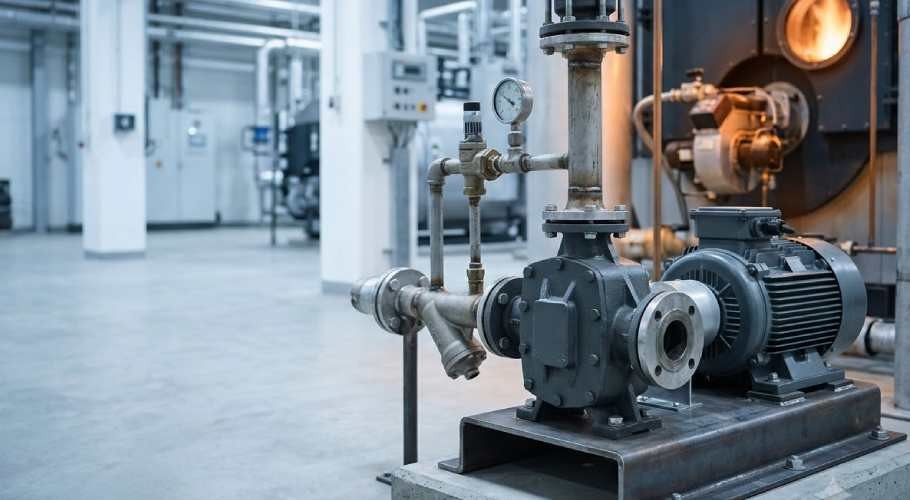
A suitable LDO pump can also self-prime, handle a wide viscosity range (from 1 cSt up to about 500 cSt when used for heated or heavier oils) and operate reliably in continuous-duty applications. You can explore our standard Rotary Gear Pump (JK) and Stainless Steel Rotary Gear Pump (JKSS) ranges for typical LDO applications.
Step 1: Calculate the Required Flow Rate (LPH / LPM)
Start with the burner's rated thermal capacity in kcal/hr, then convert it into fuel volume.
Fuel consumption (kg/hr) = Burner capacity (kcal/hr) ÷ Calorific value of LDO (kcal/kg)
Flow (LPH) = Fuel consumption (kg/hr) ÷ Density (kg/L)
For LDO, use a calorific value of approximately 10,000 kcal/kg and a density of about 0.85 kg/L. Confirm both values against your fuel supplier's data sheet.
Worked Example
Consider a burner rated at 2,000,000 kcal/hr.
- Fuel consumption: 2,000,000 ÷ 10,000 = 200 kg/hr
- Flow rate: 200 ÷ 0.85 ≈ 235 LPH
- Add a 20 to 30 percent margin for wear, line losses and future capacity.
- Recommended preliminary sizing: approximately 300 LPH or 5 LPM.
If your system uses a recirculating ring main, where excess fuel returns to the tank, the pump must supply the burner demand plus the return flow. Many installations size the pump at 1.5 to 3 times the burner consumption. State this clearly when requesting a quotation.
Step 2: Define the Working Pressure
Pressure requirements depend on the burner type, not just the flow rate.
- Low-pressure and pressure-jet burners: Commonly 5 to 25 bar at the nozzle inlet, as specified in the burner manual.
- Rotary cup and air-atomising burners: Often operate at lower pressures, around 2 to 6 bar.
Account for pressure drops across filters, pipework, valves and any height difference between the pump and burner. Select a pump with a suitable pressure rating above the required working pressure. Always install a pressure relief valve (PRV) on the discharge side, with its setting determined by the system's design limits.
Motor Power Check
kW ≈ (Flow in LPM × Pressure in bar) ÷ (600 × Efficiency)
For example, at 20 LPM, 10 bar pressure and 70 percent efficiency:
(20 × 10) ÷ (600 × 0.70) ≈ 0.48 kW
A suitable standard motor rating may be 0.75 kW, subject to the actual pump performance curve, starting conditions and application requirements.
Step 3: Confirm Viscosity and Temperature
LDO is relatively thin at operating temperature, but actual plant conditions can vary. Check the viscosity at the lowest and highest fuel temperatures expected, including cold winter mornings.
- Low viscosity: Very thin fuel increases internal slip, so actual delivery may fall below the rated figure, especially at higher pressure. Select suitable pump clearances and avoid excessive operating speeds.
- High viscosity: Cold fuel or blended and heavier oils increase power demand and suction resistance. Specify the maximum viscosity so the pump and motor can be selected correctly.
- Pump speed: Keep the speed moderate, typically 1,440 rpm or lower for continuous LDO duty. Lower speed can reduce wear and noise while improving suction performance.
Step 4: Check Suction Lift and Pipework
Suction-related problems are a common cause of LDO pump complaints. Cavitation and air ingress can result in noise, low pressure and unstable burner operation.
- Keep the suction line short and straight, with a diameter equal to or larger than the pump port.
- Limit suction vacuum to approximately 0.4 to 0.5 bar, subject to the pump manufacturer's specifications.
- Where possible, position the pump below the tank level to provide flooded suction.
- Fit a suitable suction strainer, typically 40 to 80 mesh, and clean it regularly.
- Use leak-free joints on the suction side to prevent air from entering the system.
If fuel must be lifted from a distant tank, provide the vertical height, pipe length and pipe diameter when submitting your inquiry.
Step 5: Choose the Right Materials and Shaft Seal
For standard LDO service, cast iron is a proven and economical choice. Stainless steel is preferred where corrosion, moisture contamination or other fluids are involved.
Cast Iron vs Stainless Steel LDO Pumps
| Factor | Cast Iron | Stainless Steel |
|---|---|---|
| Typical Use | Standard LDO, diesel and furnace oil | Corrosive or mixed-fluid applications, biodiesel and chemical plants |
| Corrosion Resistance | Moderate | Excellent |
| Initial Cost | Lower | Higher |
| Strength and Wear | Very good | Very good |
| Best For | General boiler and burner feed | Clean-process plants and aggressive environments |
Teflon Gland Packing vs Mechanical Seal
The shaft seal affects leakage risk and maintenance requirements.
| Factor | Teflon Gland Packing | Mechanical Seal |
|---|---|---|
| Initial Cost | Lower | Higher |
| Leakage | May require slight controlled leakage and adjustment | Very low leakage when correctly installed |
| Maintenance | Periodic tightening and replacement | Low; replacement when worn |
| Tolerance to Dirt | Generally more tolerant | Requires suitable clean operating conditions |
| Best For | Intermittent duty and budget-sensitive plants | Continuous burner operation and applications requiring minimal leakage |
For continuous boiler operation, a mechanical seal is often a suitable long-term choice because it reduces fuel leakage and housekeeping requirements.
Step 6: Plan Mounting, Drive and Safety
- Drive: Direct coupling with a flexible coupling on a common base plate is a standard arrangement. Confirm motor rating, voltage and frequency.
- Rotation: Specify clockwise or anticlockwise rotation when viewed from the shaft end.
- Safety: A pressure relief valve (PRV), non-return valve and pressure gauge on the discharge line help protect the pump and burner.
- Hazardous Areas: Specify your requirements early if a flameproof motor is necessary.
Quick Sizing Data to Send With Your Inquiry
To receive an accurate quotation for an LDO rotary gear pump, provide the following information:
- Burner capacity (kcal/hr) or required flow rate in LPH/LPM.
- Working pressure (bar).
- Fuel type, minimum and maximum temperature, and viscosity.
- Suction lift or head, pipe length and pipe diameter.
- Preferred pump material and shaft seal type.
- Motor power, voltage, frequency and other drive requirements.
Frequently Asked Questions
How do I calculate the flow rate of an LDO pump for a burner?
Divide the burner capacity in kcal/hr by the calorific value of LDO (approximately 10,000 kcal/kg) to calculate fuel consumption in kg/hr. Then divide by the fuel density (approximately 0.85 kg/L) to calculate the flow rate in LPH. Add a suitable 20 to 30 percent margin, after considering the system requirements.
What pressure does an LDO pump need for a boiler burner?
It depends on the burner type and its operating specifications. Pressure-jet burners often require 5 to 25 bar, while rotary cup burners may require less. Always follow the burner manufacturer's manual and account for pressure losses in the piping system.
Can one LDO pump handle different viscosities?
A rotary gear pump can handle a wide viscosity range, from thin LDO to oils of several hundred cSt, provided that pump speed, internal clearances and motor power are selected according to the maximum operating viscosity.
Cast iron or stainless steel for an LDO pump?
Cast iron is suitable for standard LDO applications. Stainless steel is a better option when corrosion, moisture contamination or chemical compatibility is a concern.
Mechanical seal or gland packing for an LDO pump?
A mechanical seal is generally preferred for continuous-duty applications where minimal leakage and reduced maintenance are important. Gland packing is a lower-cost alternative for suitable intermittent-duty applications.
Choose the Right LDO Rotary Gear Pump for Your Application
Selecting the right LDO pump requires careful consideration of flow rate, operating pressure, fuel viscosity, temperature, suction conditions and material compatibility. Proper pump sizing helps maintain reliable fuel delivery, supports stable burner operation and reduces unnecessary maintenance.
J K Pump Industries offers rotary gear pump solutions for industrial fuel transfer and burner feed applications. Share your operating requirements with our team to identify a suitable pump configuration.